 >
> Häufige Fragen (FAQs)
Definitionen
Nein, das sind sie nicht. Die Größe, in der ein Material vorkommt, bestimmt nicht allein über dessen Toxizität. Viele der Materialien, die in ihrer Nanoform toxische Effekte auslösen, zeigen die gleichen Effekte auch in größeren Formen. Allerdings kann die Größe speziell einen Einfluss auf die Art der Exposition und der Verteilung im Organismus haben. So gelangen z.B. Nanomaterialien nach dem Einatmen in die tieferen Bereiche der Lunge, während größere Partikel dies nicht können.
Nanomaterialien haben einzigartige Eigenschaften, welche sie für viele neuartige Anwendungen interessant machen. Gleichzeitig ergibt sich aus diesen neuen Eigenschaften auch die Besorgnis über unerwartete Gefährdungen für Mensch und Umwelt. Deshalb gab es zu dieser Frage bereits seit 2006 umfangreiche Forschungsaktivitäten. Bisher wurde kein besonderer Wirkmechanismus entdeckt, der ausschließlich bei Nanomaterialien auftritt. Vielmehr hängt die Giftigkeit einer Substanz eher von ihrer Zusammensetzung als von ihrer Größe ab.
UPDATE!
Die Europäische Kommission veröffentlichte 2011 eine erste gemeinsame Definition des Begriffs „Nanomaterial“ (2011/696/EU). Diese wurde 2022 aktualisiert:
Ein „Nanomaterial“ ist ein natürliches, zufälliges oder hergestelltes Material, das aus festen Partikeln besteht, die entweder einzeln oder als identifizierbare Teilchen in Aggregaten oder Agglomeraten vorhanden sind, und bei dem 50 % oder mehr dieser Partikel in der zahlenmäßigen Größenverteilung mindestens eine der folgenden Bedingungen erfüllen:
- eine oder mehrere Außenabmessungen des Teilchens liegen im Größenbereich von 1 nm bis 100 nm;
- das Teilchen hat eine längliche Form, wie z. B. einen Stab, eine Faser oder eine Röhre, bei der zwei Außenabmessungen kleiner als 1 nm sind und die andere Abmessung größer als 100 nm ist;
- das Teilchen hat eine plattenartige Form, bei der eine Außenabmessung kleiner als 1 nm und die andere größer als 100 nm ist.
- Bei der Bestimmung der auf der Partikelzahl basierenden Größenverteilung brauchen Partikel mit mindestens zwei orthogonalen Außenabmessungen größer als 100 μm nicht berücksichtigt zu werden
Ein Material mit einer spezifischen Oberfläche (bezogen auf das Volumen) von < 6 m2/cm3 wird jedoch nicht als Nanomaterial betrachtet.
https://ec.europa.eu/environment/chemicals/nanotech/pdf/C_2022_3689_1_EN_ACT_part1_v6.pdf
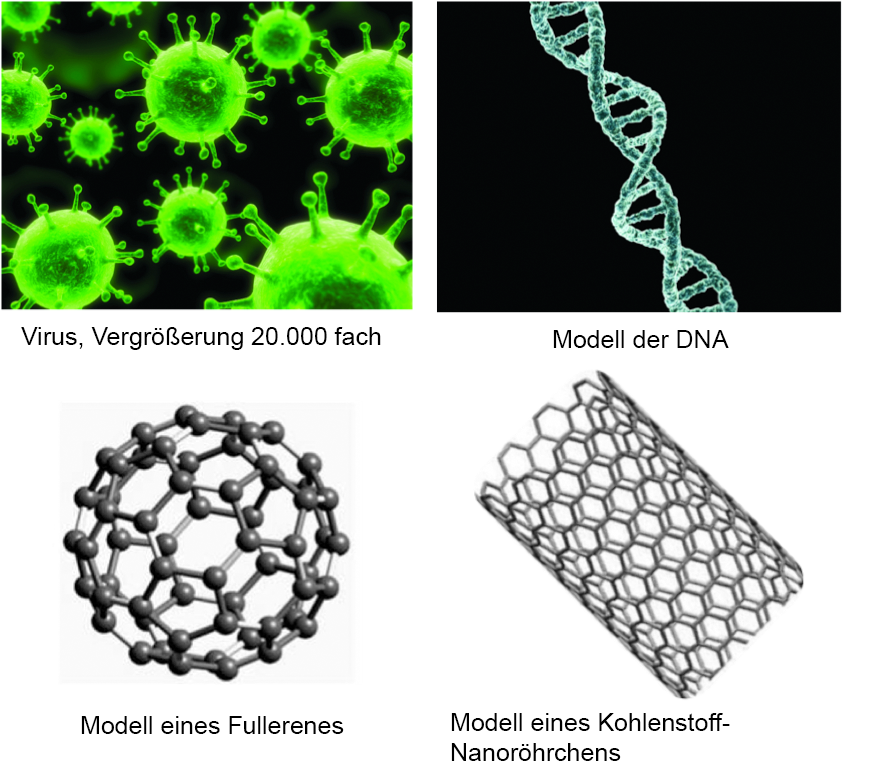
Groessenvergleich Virus DNA Fulleren CNT
Der Begriff „Nano“ leitet sich vom griechischen Wort nanos, der Zwerg, ab. Ein Nanometer ist der millionste Teil eines Millimeters oder 1/1.000.000.000 (1/1 Milliarde) eines Meters. Wenn Dinge so klein sind, kann man sie weder mit dem Auge noch mit einem Lichtmikroskop sehen. Man benötigt dazu spezielle Mikroskope, wie Elektronenmikroskope (EM) oder Rastersondenmikroskope (REM).
Der Nanomaßstab umfasst den Größenbereich von etwa 1 nm bis 100 nm.
Natürliche und synthetische Nanopartikel im Nanometer Maßstab: Virus (30-50 nm), DNA (2.5 nm), Buckyball (~1 nm im Durchmesser), CNT (~1 nm im Durchmesser).
Von einem Nanopartikel, wissenschaftlich korrekt Nanoobjekt, spricht man, wenn ein Material mit einem, zwei oder drei Außenmaß(en) im Nanomaßstab vorliegt. Dazu zählen die Nanopartikel, also Nanoobjekte mit allen drei Außenmaßen im Nanomaßstab. Nanoplättchen sind Nanoobjekte mit einem Außenmaß im Nanomaßstab und zwei wesentlich größeren Außenmaßen. Nanofasern besitzen zwei ähnliche Außenmaße im Nanomaßstab und ein drittes Außenmaß, das wesentlich größer als die beiden anderen Außenmaße ist.
Diese Definitionen wurden als Deutsche Industrie Norm DIN CEN ISO/TS 80004-2:2017-09;DIN SPEC 52400-2:2017-09, veröffentlicht. Das zuständige deutsche Gremium ist der Arbeitsausschuss NA 062-08-17 AA im Normenausschuss Materialprüfung (NMP). Siehe dazu auch Deutsches Institut für Normung e.V., DIN
Nanopartikel können unterschiedlicher chemischer Natur sein. Sowohl anorganische als auch organische Nanopartikel sind bekannt. Sie können aus nur einem Element bestehen, z.B. aus Metall oder aus Kohlenstoff oder aber aus Verbindungen, wie Oxiden, Nitriden usw. Unter Nanokompositen versteht man Verbundmaterialien, in denen mindestens eine Komponente in Form von Nanoobjekten vorliegt. Nanopartikel lagern sich häufig aneinander und bilden Aggregate oder Agglomerate. Im Gegensatz zu Aggregaten können Agglomerate durch optimales Durchmischen in die Primärkörner zerkleinert werden. Deshalb kann ihre Gestalt sehr uneinheitlich sein und verschiedenste Formen annehmen mit erheblichem Einfluss auf ihre Eigenschaften. Grundsätzlich verhalten sich Nanopartikel wegen ihres enormen Oberfläche-zu-Masse-Verhältnisses gänzlich anders als größere Verbünde.
Arbeitsplatz
Falls beim Umgang mit Nanomaterialien die Freisetzung NICHT über technische Schutzmaßnahmen verhindert werden kann, empfiehlt die Deutsche Gesetzliche Unfallversicherung (DGUV) einen persönlichen Atemschutz der Filterklasse P3 oder P2. Für die Auswahl des persönlichen Atemschutzes spielt die vorangegangene Gefährdungsbeurteilung eine große Rolle.
Ist das Tragen einer Atemschutzmaske notwendig, dann muss diese dicht an Gesicht bzw. Kopf anliegen. Ebenso müssen auch die geltenden Tragezeitbegrenzungen und Regelungen zu arbeitsmedizinischen Vorsorgeuntersuchungen beim Tragen des Atemschutzes beachtet werden. Neben dem persönlichen Schutz sind auch eine entsprechende Unterweisung und Training der Beschäftigten wichtig.
- Weitere Informationen zu diesem Thema finden Sie auf den Seiten der Deutsche Gesetzliche Unfallversicherung (DGUV) oder in unserer FAQ „Wer ist zuständig für den Arbeitsschutz beim Umgang mit Nanomaterialien und wo kann ich mich darüber informieren?„
Generell verantwortlich für den Arbeitsschutz ist der Arbeitgeber. Dies gilt auch für den Umgang mit Nanomaterialien am Arbeitsplatz. Der Arbeitgeber ist zuständig für alle grundsätzlichen Unterweisungen, die Beurteilung des Risikos und der möglichen Gefährdung am Arbeitsplatz sowie den dazugehörigen Schutzmaßnahmen. Der Arbeitnehmer hat entsprechend umsichtig zu handeln und den Arbeitgeber auf mögliche Gefahren hinzuweisen. Die Europäischen Arbeitsschutzgesetze umfassen auch den Umgang mit Nanomaterialien. Es gelten die gleichen hierarchisch abgestuften Maßnahmen („STOP“) wie für einen verantwortungsbewussten Umgang mit gefährlichen Stoffen.
- Substitution
- Technische Maßnahmen an der Quelle
- Organisatorische Maßnahmen
- Persönliche (individuelle) Schutzmaßnahmen
Weitere Informationen zum Thema Arbeitsschutz & Nanomaterialien sind auf den Internet-Seiten der zuständigen nationalen Behörden, Versicherer oder der Europäischen Agentur für Arbeitssicherheit und –gesundheit (EU OSHA) zu finden.
Deutschland
- Bundesanstalt für Arbeitsschutz und Arbeitsmedizin (BAuA) – Nanotechnologie
- Nanoportal der Deutschen Gesetzlichen Unfallversicherung (DGUV)
- Deutschen Gesetzlichen Unfallversicherung (DGUV) – Ultrafeine Aerosole und Nanopartikel am Arbeitsplatz
Schweiz
- Schweizer Bundesamt für Gesundheit (BAG) – Gesundheitsschutz am Arbeitsplatz
- Eidgenössische Koordinationskommission für Arbeitssicherheit (EKAS)
- Schweizer Unfall Versicherung (SUVA) – Nanopartikel an Arbeitsplätzen
Österreich
- Arbeitsinspektion (Bundesministeriums für Arbeit, Soziales und Konsumentenschutz) – Nanomaterialien
- Nanoinformation Portal – Arbeitswelt
Europäische Union
- Europäischen Agentur für Arbeitssicherheit und –gesundheit (EU OSHA) – Umgang mit Nanomaterialien am Arbeitsplatz
Bisher gibt es keine EU-weiten Arbeitsplatzgrenzwerte, es wird jedoch an der Festlegung solcher Werte gearbeitet. Bisher werden Arbeitsschutzmaßnahmen für den Umgang mit Nanomaterialien nach dem Vorsorgeprinzip von bestehendem Wissen zu Sicherheitsmaßnahmen für den Umgang mit Chemikalien abgeleitet. Das beinhaltet vor allem die Vermeidung von Kontakt mit den Partikeln (Exposition) und Anwendung persönlicher Schutzausrüstung (z.B. Atemschutz, Schutzhandschuhe).
In Deutschland befasst sich insbesondere die Bundesanstalt für Arbeitsschutz und Arbeitsmedizin (BAuA) mit der Nanothematik, in der Schweiz hat das Bundesamt für Gesundheit (BAG) ein Vorsorgeraster für synthetische Nanomaterialien erstellt.
Weiterführende Links:
- Bundesanstalt für Arbeitsschutz und Arbeitsmedizin (BAuA) – Nanotechnologie
- Bundesamt für Gesundheit (BAG) – Schweizer Vorsorgeraster
- Broschüre „Safe handling of nano materials and other advanced materials at workplaces“ (2015)
- Europäisches Vorsorgeprinzip (letzter Stand: 21.09.2015)
Anwendungen/Produkte
Bei Festkörper- oder auch Feststoffbatterien liegen beide Elektroden und der Elektrolyt als festes Material vor. Obwohl sich bereits einige Festkörperbatterien in der Anwendung in Elektroautos bzw. –lastwagen (z.B. im „Bollore Blue Car“)befinden, sind die meisten aktuell noch in der Entwicklung.
Die Vorteile von Festkörperbatterien (engl. All-Solid-State Batteries, ASSB) gegenüber den gängigen Flüssigelektrolytbatterien sind der Ersatz des (meist leicht entzündlichen) Flüssigelektrolyts durch einen Feststoffelektrolyten. Weiterhin weisen Festkörperbatterien eine höhere Energiedichte und eine schnellere Ladefähigkeit auf, was für die zunehmende Elektromobilität bedeutend ist.
Für Festkörperbatterien kommen verschiedene Materialien wie Polymere, Metalle, Keramiken in unterschiedlichen Kombinationen zum Einsatz.
Flüssig-Elektrolytbatterien werden seit vielen Jahren angewendet und sind derzeit die am häufigsten eingesetzten Batterien, z.B. Lithium-Ionen-Batterien (LIB) in Mobiltelefonen. Bei Flüssigbatterien liegen die Elektrolyte in gelöster Form vor, die Elektroden bestehen jedoch aus einem festen Material. Die Flüssigelektrolyte sind meist leicht entzündlich, was häufig als Nachteil gesehen wird. Daher befinden sich derzeit Festkörperbatterien in der Entwicklung, bei welchen die Elektrolyte in fester Form vorliegen.
Flüssige Elektrolyte sind meist wasserbasierte Salzlösungen, die aus organischen und anorganischen Säuren bestehen. Aber auch einfache Kochsalzlösungen können zum Einsatz kommen.
Es gibt eine Vielzahl von Akkus oder Sekundärbatterien, die sich grob in Flüssig-Elektrolytbatterien (auch Nasszelle genannt) und Festkörperbatterien einteilen lassen. Generell bestehen sie aus 2 Elektroden und einen Elektrolyt, die jeweils aus unterschiedlichen Materialien bestehen können.
Der Großteil der derzeit und auch in naher Zukunft eingesetzten Akkus sind Flüssigelektrolytbatterien, hauptsächlich Lithiumionenbatterien.
Einige Festkörperbatterien befinden sich bereits in der Anwendung, die meisten anderen befinden sich derzeit in der Grundlagenforschung. Verwendete Materialien sind beispielsweise Natrium, Magnesium oder Aluminium.
Herkömmliche Solarzellen bestehen oft aus Silizium, das in amorpher oder kristalliner Form eingesetzt wird. Man braucht viel Know-How und Geld, um es herzustellen und die Ausbeute bei der Lichtenergieumwandlung in kommerziellen Produkten liegt unter 25% [1]. Deshalb werden auch Solarzellen aus anderen Elementen hergestellt. Zu den prominentesten Vertretern zählen hier GaAs (Galliumarsenid), CdTe- (Cadmium-Tellur) und CIGS- (Kupfer-Indium-Gallium-Selen) Solarzellen. Diese Elemente sind umstritten, da einige z.B. giftig, nur schwer aus sozial / ethisch vertretbaren Quellen zu beziehen und meist sehr teuer sind.
Deshalb werden nachhaltige Alternativen gesucht: Perowskit-Solarzellen könnten billiger herzustellen und die Ausgangsstoffe leichter zu beschaffen sein. Allerdings enthalten sie ebenfalls giftige Elemente (Stand 2022). Daher wird an weniger toxischen Perowskit-Solarzellen intensiv geforscht. Im Labor wurden bereits gute Lichtausbeuten erzielt und speziell die Möglichkeit, halbtransparente Zellen zu bauen, könnte zu sehr hohen Ausbeuten bei der Lichtenergieumwandlung führen, wenn Perowskit- und herkömmliche Solarzellen übereinander angeordnet werden (Tandem-Solarzelle).
Weiterführende Informationen:
- US National Renewable Energy Laboratory (NREL) – Best Research-Cell Efficiency Chart
Acrylharze sind besonders haltbare Kunstharze und kommen in vielen Klebstoffen, Farben und Lacken zum Einsatz. Vor der Aushärtung liegen sie in flüssiger Form als Monomere vor und sind damit keine Nanopartikel. Aufgrund der vielseitigen Anwendungsmöglichkeiten können sie jedoch verschiedene Zusätze enthalten, die z.B. aus Nanopartikel bestehen. Ein Gesundheitsrisiko besteht für die Nanopartikel jedoch nicht, da sie sowohl in der flüssigen, als auch in der ausgehärteten Form fest in der jeweiligen Umgebung eingebunden sind und nicht entweichen können.
Silber Nanopartikel verleihen Plastikverpackungsmaterialien antimikrobielle Eigenschaften und können über die gezielte Freisetzung von Silber-Ionen das Wachstum lebensmittelschädlicher Mikroorganismen verhindern. Es besteht die Möglichkeit, dass neben den Silber-Ionen auch Silber Nanopartikel aus der Verpackung freigesetzt werden und in die Lebensmittel übergehen. Dieser Punkt ist aus Forschungssicht noch nicht abschließend geklärt und wird weiter untersucht. Nanosilber, eines der prominentesten Beispiele, welches in den USA, Asien oder Australien üblicherweise verwendet wird, darf aktuell in der EU nicht in Plastikverpackungen für Lebensmittel verarbeitet werden.
- Weitere Informationen zu diesem Thema finden Sie in den Querschnittsthemen im Artikel „Nanomaterialien in Lebensmittelverpackungen“
In der Europäischen Union kommen zurzeit keine gezielt hergestellten Nanomaterialien in Lebensmitteln zum Einsatz. Es können allerdings nanogroße Nebenprodukte bei der Herstellung von zugelassenen Lebensmittelzusatzstoffen entstehen, z.B. von Siliziumdioxid. In Asien und Nordamerika hingegen werden Nanomaterialien zielgerichtet in Lebensmitteln eingesetzt, z.B. zur Verkapselung von Vitaminen. Grundsätzlich sieht die Mehrheit der vorhandenen Studien kein gesundheitliches Risiko für den Menschen. Die Gesetzgebung erlaubt nur unschädliche (sichere) Zugaben zu Lebensmitteln. Das bedeutet, dass in der EU erlaubte Zusatzstoffe für Lebensmittel zuvor getestet und vom Gesetzgeber zugelassen sein müssen. Dies richtet sich aber immer auch nach dem aktuellen Stand der Wissenschaft und wird ständig überarbeitet.
- Weitere Informationen zu diesem Thema finden Sie Querschnittsthemen im Artikel „Nanomaterialien in Lebensmitteln“.
Über spezielle Beschichtungen können selbstreinigende Oberflächen bzw. ein Graffiti-Schutz erzeugt werden. Diese sind nahezu unsichtbar und schützen das Basismaterial ohne dessen Aussehen zu verändern. An solchen glatten, wasserabweisenden Oberflächen (Fassaden, Fenster, Wände, Fahrzeuge) haften Schmutzpartikel nur sehr schlecht, so dass sie leicht wieder abgespült und entfernt werden können. Eine universelle Beschichtung existiert aufgrund der großen Vielfalt an Basismaterialien nicht, sondern die Beschichtung wird an das jeweilige System angepasst.
Bei der Verarbeitung und dem Aufbringen der verschiedenen Beschichtungen gelten dieselben präventiven Schutzmaßnahmen wie für andere Farben oder Lacke, so z.B. das Tragen entsprechender Schutzkleidung oder Atemmasken.
Nach dem Trocknen sind mögliche vorhandenen Nanopartikel fest in die Beschichtung eingebunden. Wie auch bei nano-haltigen Farben werden unter Umweltbedingungen (Wind, Regen) kaum Nanopartikel freigesetzt. Falls Partikel frei werden, lagern sich diese an andere Partikel an oder klumpen mit sich selbst zusammen. Deshalb treten keine einzelnen Nanopartikel in der Luft oder im Wasser auf.
- Weitere Informationen finden Sie in unserem Querschnittsartikel „Nanopartikel in Farben„!!!
Nein, die Wirksamkeit der anorganischen (auch als mineralische UV-Filter bezeichnet) und organischen UV-Filter in der Sonnencreme ist dann gegeben, wenn die Materialien in Nanoform oder größer als dünner Film auf der Haut aufliegen. Bei sachgemäßer Anwendung auf gesunder Haut (nicht auf Schleimhäuten oder verletzter Haut) gelangen diese nicht in den Körper und werden durch Schweiß und Wasser wieder von der Hautoberfläche abgewaschen.
- Weitere Informationen zum Thema „Nanopartikel und die Haut“ finden Sie bei unseren Querschnittsthemen!!!
Bei sachgemäßer Anwendung auf gesunder Haut (z.B. nicht auf Schleimhäute oder Wunden) können die typischerweise in Sonnencremes enthaltenen Nanomaterialien Titandioxid oder Zinkoxid (anorganische UV-Filter) als auch die organischen nanoskaligen UV-Filter MBBT oder TBPT nicht durch die Barriere Haut in den Körper eindringen. Bei sonnengeschädigter Haut verbleiben die Nanomaterialien in den obersten Hautschichten (Epidermis). Deshalb ist in beiden Fälle auch keine Verteilung über die Blutbahn im Körper zu erwarten.
- Weitere Informationen zum Thema „Nanopartikel und die Haut“ finden Sie bei unseren Querschnittsthemen!!!
Häufig werden Silberfäden in den Bezug der Matratze eingesponnen. Zusätzlich kann das Gewebe noch mit einer Silberlösung getränkt werden.
Das Ziel derartig ausgerüsteter Textilien ist eine antimikrobielle Wirkung: An der Oberfläche metallischen Silbers werden besonders bei Feuchtigkeit positiv geladene Ionen frei. Diese wirken gegen Bakterien, Hefen und Pilze, und zwar unabhängig davon, ob direkt Silberionen in Form von Silbersalzen vorliegen oder die Ionen aus Metallpartikeln – gleich welcher Größe – freiwerden. Allerdings haben Nanosilberpartikel bei sehr geringem Durchmesser eine vergleichsweise riesige Oberfläche, weswegen sie im Vergleich zu größeren Partikeln viel mehr Silberionen freisetzen und dadurch stärker antimikrobiell wirken. Nach dem bisherigen Kenntnisstand ist eine Silber-Ausrüstung wie in der Matratze nicht gesundheitlich bedenklich.
- Weitere Information zum Thema „Nano in Textilien“ finden Sie bei unseren Querschnittsthemen !!!
Das Schweizer Projekt NanoSafe Textiles hat sorgfältig die Trends für die Anwendung von Nanomaterialien in der Textilindustrie evaluiert und zusammen mit potentiellen Risiken solcher Nanotextilien für Mensch und Umwelt über deren gesamten Lebenszyklus bewertet. Ausgehend von diesen Ergebnissen wurde ein Leitfaden für die Textilindustrie erstellt, mit dem sich nachhaltig sichere Nanotextilien herstellen lassen.
- Der Leitfaden sowie weitere Information zum Thema „Nano in Textilien“ finden Sie bei unseren Querschnittsthemen!!!!
Hauptsächlich soll die Löslichkeit der aktiven Komponente durch den Einsatz von Nanomaterialien verbessert werden. Gegenüber dem konventionellen Pestizid ergeben sich dadurch Vorteile hinsichtlich des kontrollierten und gezielten Einsatzes, dem Schutz vor dem Abbau der aktiven Substanz und damit generell eine verbesserte Wirksamkeit des Pestizids. Insgesamt soll es dadurch ermöglicht werden die eingesetzten Mengen an aktiver Substanz zu verringern und trotzdem eine vergleichbare oder sogar verbesserte Wirksamkeit des Pestizids zu erreichen.
- Weitere Informationen zu diesem Thema finden Sie im Querschnittsartikel – „Nanomaterialien in Pflanzenschutzmitteln„!
Nein. Eine Rückgewinnung von Nanomaterialien aus einem Produkt ist nicht möglich, da die Nanomaterialien häufig in eine Matrix eingebettet sind und eine Abtrennung der Nanomaterialien technisch nicht möglich ist. Jedoch wird ein Großteil der Produkte die Nanomaterialien enthalten, wiederverwertet (z.B. Kunststoffe, elektronische Güter).
- Weitere Informationen zu diesem Thema finden Sie im Querschnittsartikel – „Nanomaterialien im Abfall“!
Unter Nanoplastik versteht man Partikel, die aus verschiedenen Kunststoffen (z.B. PET – Polyethylenterephthalat, PS – Polystyrol) bestehen. Je nach verwendeter Definition sind sie kleiner als 1 µm bzw. kleiner als 100 nm. Der Begriff Nanoplastik beschreibt also kein einheitliches Material. Wichtig ist es, zwischen primärem und sekundärem Nanoplastik zu unterscheiden.
Primäre Nanoplastik Partikel werden gezielt hergestellt und finden in verschiedenen Kosmetikprodukten, Waschpulvern, sowie in Forschung und Diagnostik Anwendung. Sie sind zumeist von definierter Größe bzw. Größenverteilung und bestehen in einer Anwendung in der Regel aus nur einem Polymertyp.
Sekundäres Nanoplastik entsteht in der Umwelt, insbesondere in Flüssen und den Weltmeeren, durch die Zerkleinerung (´Fragmentierung´) von größeren Plastikstücken. Letztere gelangen durch die unsachgemäße Entsorgung von Müll in die Umwelt und werden durch den Einfluss von Sonne, Wind und Wellen in immer kleinere Stücke zerlegt. Nachdem aus den großen Stücken zunächst sogenanntes Meso- und Mikroplastik entstanden ist, zerfallen diese Partikel in noch kleineres Nanoplastik. Je nach Zusammensetzung des Mülls besteht Nanoplastik aus einer Mischung verschiedener Polymere.
Im Prinzip besteht der Unterschied zwischen Nano- und Mikroplastik lediglich in der Partikelgröße. Als Mikroplastik werden Plastikstücke aus PET (Polyethylenterephthalat), PP (Polypropylen), PE (Polyethylen) oder anderen Kunststoffen bezeichnet, welche kleiner als 5 mm sind. Eine einheitliche Definition für Mikroplastik existiert derzeit noch nicht. Unter dem Begriff „primäres Mikroplastik“ fallen industriell hergestellte Produkte für z.B. kosmetische Produkte, Waschmittel oder auch Wirkstoffträger in der Medizin. Den größten Teil macht jedoch „sekundäres“ Mikroplastik aus, welches in der Umwelt durch die Zersetzung von Kunststoffabfällen entsteht. Durch immer weitere Zerkleinerung entsteht schließlich auch Nanoplastik.
Mikroplastik steht aktuell in der Diskussion, schädliche Auswirkungen auf die Umwelt zu haben. Diese Fragestellung wird von verschiedenen Stellen auf nationaler und europäischer Ebene intensiv untersucht. Die Bildung einer nanoskaligen Kunststofffraktion unter Umweltbedingungen konnte bereits nachgewiesen werden, allerdings gibt es zurzeit noch keine Studien zu deren möglichen negativen Effekten für Fauna und Flora.
Für Nanomaterialien hingegen besteht bereits eine Definition. Ihre Zusammensetzungen sind nicht auf Kunststoffpolymere begrenzt, sondern beinhalten auch Metalle oder Kohlenstoff-basierte Materialien. Intensive Forschungsaktivitäten der letzten Jahre geben Aufschluß zu möglichen Effekten von Nanomaterialien auf Mensch und Umwelt.
Forschungsaktivitäten zum Thema Mikroplastik:
Silber wird seit Jahrtausenden eingesetzt, um z.B. Wasser keimfrei zu halten. Neuerdings kann dafür auch Nanosilber eingesetzt werden. Ob aber tatsächlich Nanosilber auf der Oberfläche eines Kühlschrankes verwendet wird, ist meist nicht direkt ersichtlich. Eine Exposition des Nutzers solcher Geräte ist in jedem Fall sehr klein und hat keine gesundheitliche Relevanz. Die Menge an Silber, die wir über die Nutzung von Silberbesteck zu uns nehmen, ist deutlich größer, aber immer noch weit unter der toxikologisch bedenklichen Schwelle.
Weitere Informationen zu Silber finden Sie unter www.nanopartikel.info/wissen/materialien/silber/
In Lebensmittelverpackungen gibt es sehr unterschiedliche Anwendungsmöglichkeiten für Nanomaterialien, daher ist eine generelle Antwort nicht möglich. Sicher gibt es einzelne, bestimmte Produkte zu kaufen, in denen Nanomaterialien verwendet wurden. In der EU dürfen „von Lebensmittelkontaktmaterialien gemäß der Verordnung (EG) Nr. 1935/2004 keine Gesundheitsgefahren für den Menschen ausgehen und zwar unabhängig von der Partikelgröße der eingesetzten Stoffe und der Art der Materialien“.
Siehe auch: http://eur-lex.europa.eu/legal-content/DE/TXT/?uri=celex:32004R1935
In Sonnencremes kommen zwei verschiedene Filter-Gruppen zum Schutz vor UV-Strahlung zum Einsatz: anorganische (auch mineralisch genannt) als auch organische UV-Filter. Beide Typen absorbieren häufig die Strahlung und geben sie energieärmer (z.B. als Wärme) wieder ab; ein Teil der Strahlung kann aber auch reflektiert werden. Organische wie anorganische UV-Filter können in Nanoform enthalten sein. Aus der ersten Gruppe gibt es MBBT und TBPT als organische Verbindungen aber als unlösliche Nanopartikel, die UV-Licht absorbieren. Titandioxid oder auch Zinkoxid zählen zur Gruppe der anorganischen UV-Filter. Die Nanoformen hinterlassen auf der Haut keinen weißen Film, was viele Anwender aus ästhetischen Gründen bevorzugen.
- Weitere Informationen zum Thema „Nanopartikel und die Haut“ finden Sie bei unseren Querschnittsthemen!!
Nanomaterialien können einerseits bestehenden Eigenschaften der Textilien verbessern oder für völlig neue Funktionalitäten einbringen. So werden Textilien schmutz- und wasserabweisend, atmungsaktiv, leitfähig und antistatisch. Sie schützen vor UV-Licht, schaffen eine erhöhte Verschleiß- und Knitterbeständigkeit oder Unempfindlichkeit gegen Flecken, oder reduzieren den Befall durch Bakterien oder Pilze.
Über den Ersatz herkömmlicher Materialien durch Nanomaterialien können auch umwelt- und gesundheitsbezogene Auswirkungen sowie Umweltbelastungen verringert werden. Es wird weniger Material für das gleiche Endergebnis in den Textilien benötigt und über eine verringerte Waschfrequenz kann Energie und Wasser eingespart werden.
- Weitere Information zum Thema „Nano in Textilien“ finden Sie bei unseren Querschnittsthemen!!!!
Titandioxid (chem. TiO2) kommt vornehmlich als Weißpigment in Farben zum Einsatz. Eine „Weiß-Färbung“ kann nur durch mikrometer-großes und nicht durch nanoskaliges Titandioxid erzielt werden. In Nano-Form wirkt Titandioxid als UV Schutz und kann über die Bildung von Radikalen organisches Material zersetzen und so z.B. Oberflächen reinigen.
- Mehr Informationen zum Thema Nano in Farben finden Sie im Querschnittsartikel „Nanopartikel in Farben„!!!
E-Nummern sind wie jede Deklaration auf Lebensmittelverpackungen eine reine Inhaltsangabe, jedoch kein Gefährdungshinweis. Die Gesetzgebung verlangt, dass nur unschädliche (sichere) Zugaben zu Lebensmitteln erlaubt sind, daher sind alle Zusatzstoffe getestet und müssen vom Gesetzgeber zugelassen sein. Dies richtet sich aber immer auch nach dem aktuellen Stand der Wissenschaft und wird ständig überarbeitet. Die beiden Stoffe Siliziumdioxid (SiO2, Kieselsäure, E551) und Eisenoxide (E172) sind für bestimmte Anwendungen zugelassen und liegen „teilweise“ auch in Nanoform vor. Für die Verwendung in Lebensmitteln ist allerdings der Nanoanteil nicht wichtig, sondern nur ein produktionsbedingter Bestandteil.
Weitere Informationen :
- Bundesministerium für Ernährung und Landwirtschaft (BMEL): https://www.bmel.de/DE/Ernaehrung/SichereLebensmittel/SpezielleLebensmittelUndZusaetze/Zusatzstoffe/_Texte/Lebensmittelzusatzstoffe.html
- EU-Portal Food Additives: https://ec.europa.eu/food/food-feed-portal/screen/food-additives/search
Ja, während des Druckprozesses entstehen Nanomaterialien, welche als Feinstaub in die Umgebung freigesetzt werden. Da diese Stäube tief in die Lungen eindringen können, werden heutzutage Drucker und Kopierer nicht direkt in Büros aufgestellt, sondern außerhalb in abgegrenzten Räumen untergebracht.
- Weitere Informationen zum Thema „Toner“ finden Sie bei unseren Querschnittsthemen!!!
Wissenschaftliche Studien haben gezeigt, dass Nano-Farben per se nicht schädlicher als herkömmliche Farben für die Gesundheit sind. Beim Verwenden, Verarbeiten und der späteren Entsorgung der Farben gelten die gleichen präventiven Schutzmaßnahmen. Staubbildung sollte vermieden und insbesondere bei der Verwendung pulverförmiger Stoffe geeignete Schutzkleidung bzw. Atemschutzmasken zum Einsatz kommen.
- Mehr Informationen zum Thema „Nano in Farben“ finden Sie bei unseren Querschnittsthemen !!!
Die Reinigung von verschmutzten Wässern oder Böden von gefährlichen Chemikalien ist zeit- und kostenintensiv. Bisher muss kontaminiertes Wasser oder Boden aus der Umwelt entfernt und nach aufwändiger Reinigung wieder zurückgebracht werden. Nicht-mehr zu reinigender Boden oder Wasser wird als Müll behandelt, der verbrannt oder deponiert wird. Hier bieten Nanomaterialien zwei entscheidende Vorteile: (1) Sie können direkt in das verschmutzte Medium (Wasser, Boden) eingebracht werden (2) die Entfernung der Schadstoffe ist durch die höhere Reaktivität der Nanomaterialien viel effektiver.
Beispiele hierzu wurden in den BMBF-geförderten Projekten Fe-NANOSIT, NanoSan und NAPASAN erforscht und Anwendungen entwickelt.
Unter dem Begriff Produktionszahlen versteht man die industriell hergestellte Masse eines Materials bezogen auf eine Region und Zeit. Allgemeine Produktionszahlen speziell zu Nanomaterialien sind leider nicht öffentlich verfügbar, sondern nur aus verschiedenen Veröffentlichungen aus Forschung und Industrie zu erhalten. Eine Übersicht der Produktionszahlen von 10 verschiedenen Nanoobjekten ist z.B. im Beitrag von Piccinno aus dem Jahr 2012 zu finden. Allgemein reichen die industriellen Produktionszahlen von ca. 60.000 t pro Jahr für „klassische“ Nanoobjekte bis hinunter auf wenige Kilogramm für Spezialnanomaterialien.
- Piccinno, F., Gottschalk, F., Seeger, S. et al. Industrial production quantities and uses of ten engineered nanomaterials in Europe and the world. J Nanopart Res 14, 1109 (2012). https://doi.org/10.1007/s11051-012-1109-9
Im Allgemeinen sind die Partikel fest in der Wandfarbe eingebettet. Reine Partikel in Nanogröße werden kaum ausgelöst. Studien mit Sandstrahlern (!) haben gezeigt, dass Partikel dabei herausgelöst werden können, wenn auch nur in geringem Umfang. Falls Partikel frei werden, lagern sich diese an andere Partikel an oder klumpen mit sich selbst zusammen. Deshalb treten luftgetragene einzelne Nanopartikel nicht auf, was auch von anderen Studien bestätigt wurde. Silber in geringen Mengen ist für den Menschen unbedenklich. Einige Umweltorganismen wie z.B. Fische reagieren empfindlich gegenüber Silber. Da in aktuellen Studien die abgeschätzten Mengen für freigesetztes Silber unterhalb der Nachweisgrenze lagen, ist derzeit von keinem Risiko für die Umwelt auszugehen.
- Mehr Informationen zum Thema „Nano in Farben“ finden Sie bei unseren Querschnittsthemen !!!
Nach Rücksprache mit einem internationalen Schokoriegelhersteller wurde und wird keinerlei Nanotechnologie in Zusammenhang mit deren Schokolade eingesetzt, noch wurden und werden Nanopartikel verwendet. In Deutschland wird bislang kein nano-skaliges Titandioxid (TiO2) für Lebensmittel eingesetzt.
Ein Patent enthält eine Methode für eine Beschichtung im „Plasma“, was jedoch bedeutet, dass die Schokolade anschmilzt, was den gewünschten Effekt der besseren Haltbarkeit bzw. des besseren Aussehens für längere Zeit konterkariert. Daher wurde dieses Patent niemals angewendet! Auch andere Lebensmittel kann man einem Plasma nicht aussetzen.
Im Moment nur bedingt: einerseits wird für Produkte mit dem Attribut „Nano“ geworben, in denen gar kein „Nano“ drin ist. Andererseits gibt es nur wenige Produktgruppen, in denen Nanomaterialien gekennzeichnet werden müssen:
Für Kosmetika gilt gemäß der EU-Verordnung Nr. 1223/2009: „Alle Bestandteile in der Form von Nanomaterialien müssen eindeutig in der Liste der Bestandteile aufgeführt werden. Den Namen dieser Bestandteile muss das Wort „Nano“ in Klammern folgen.“ In der Liste der Inhaltsstoffe, die auf jedem kosmetischen Mittel die genaue Zusammensetzung wiedergibt, findet sich dann beispielsweise der anorganische (auf mineralisch genannt) UV-Filter Titandioxid als „TITANIUM DIOXIDE (nano)“.
Auch in der Zutatenliste von Lebensmitteln müssten Nanomaterialien entsprechend hervorgehoben werden. Aus der EU-Verordnung Nr. 1169/2011: „Alle Zutaten, die in Form technisch hergestellter Nanomaterialien vorhanden sind, müssen im Zutatenverzeichnis eindeutig aufgeführt werden. Auf die Bezeichnung solcher Zutaten muss das in Klammern gesetzte Wort „Nano“ folgen.“ Da bisher aber weder Zusatzstoffe noch andere Zutaten in Nanoform zugelassen sind und eingesetzt werden, gibt es bisher keine Zutatenlisten, in denen sich dieser Hinweis finden ließe.
Ähnlich verhält es sich mit den Bioziden, also Produkten, die gegen kleine und große Schädlinge eingesetzt werden. Hier gilt die EU-Verordnung Nr. 528/2012 (Biozid-Verordnung) Auch auf ihren Verpackungen muss angegeben werden, wenn Wirkstoffe in Nanoform eingesetzt werden.
Sanitär-Keramiken mit „Nanotechnologie“ sind meist oberflächenstrukturiert, so dass sich ein schmutzabweisender „Lotus-Effekt“ ergibt, wie dies bei Pflanzenblättern sehr schön zu beobachten ist. Damit sollen die Oberflächen schön sauber bleiben bzw. einfach zu reinigen sein. Dafür werden keine Nanopartikel eingesetzt oder auf die Oberfläche aufgebracht, sondern die Oberfläche wird mit Chemikalien behandelt, um diese Struktur zu erhalten.
Es ist im Einzelfall nicht auszuschließen, dass ein Hersteller aber dennoch die Oberfläche mit Nanopartikeln nachbehandelt, daher sollte man sich beim Kauf darüber informieren lassen oder beim Hersteller nachfragen. Die Wahrscheinlichkeit, sich über diesen Weg Nanopartikeln auszusetzen, ist sehr gering.
Silber hat als Metall selbst kaum eine Wirkung, auch Nanopartikel aus Silber auf der Tastatur haben „keine Wirkung“. Erst wenn Silberionen aus den Partikeln herausgelöst werden, beginnt die antibakterielle Wirkung. Jedoch ist die auf den Tastaturen aufgebrachte Menge an Silber äußerst gering, so dass die freiwerdenden Ionen im Vergleich zu beispielsweise Silberbesteck nicht wirklich ins Gewicht fallen. Vom Besteck lösen sich weit mehr Ionen, da es ja mit Nahrungsmitteln, Wasser, Säure etc. in Kontakt kommt. Außerdem muss geprüft werden, ob es sich tatsächlich um eine Silberbeschichtung handelt oder nur um eine Werbeaussage.
Ca. 4,7 Mio Tonnen an pigmentärem Titandioxid (nicht nanoskalig) werden jährlich produziert, die Produktionsmenge von nanoskaligem Titandioxid beträgt weniger als 1 % davon (weniger als ca. 47.000 Tonnen).
Es gibt einige Webseiten, die Produkte der Nanotechnologie auflisten:
- The Nanodatabase (Englisch): https://nanodb.dk/en/search-database/
- The Project of Emerging Nanotechnologies (in Englisch): https://nanotechproject.tech/cpi/
Bei Kosmetika müssen seit Juli 2013, bei Lebensmitteln und Lebensmittelverpackungen seit Dezember 2014 enthaltene „nano“ Inhaltsstoffe deklariert werden.
Solche Antihaft-Beschichtungen von Kochgeschirr haben üblicherweise nichts mit Nanopartikeln zu tun. Hier werden Polymere verwendet, die als Schicht aufgetragen werden und sehr hitzebeständig sein müssen. Diese Oberflächen sind ähnlich dem bekannten Effekt der Lotuspflanze und lassen alle Flüssigkeiten abperlen.
Da die Hersteller meist ein Geheimnis (Patent) aus der Art der Beschichtung machen, ist eine genaue Auskunft zu einer möglichen Gefährdung so nicht möglich. Aber es muss auch bedacht werden, dass gesetzlich vorgeschrieben ist, „nur sichere Verbraucherprodukte“ auf den Markt zu bringen, daher sollte das hier auch der Fall sein.
Sie lesen hier unsere Meinung zu einem Thema, jeglichen Haftungsanspruch schließen wir aus.
Der Begriff „nano“ ist nicht geschützt. Es garantiert niemand, dass auch wirklich „nano“ in dem entsprechenden Produkt enthalten ist. Manche Hersteller verwenden den Begriff, weil er werbewirksam erscheint.
Der Lackverband hat eine Studie durchgeführt, in der Nanopartikel in Lacken untersucht werden. Das Resultat wird als positiv (aus Verbrauchersicht) beschrieben. https://www.wirsindfarbe.de/service-publikationen/sonstige-veroeffentlichungen/vdl-veroeffentlicht-broschuere-ueber-die-freisetzung-von-nano-objekten-aus-beschichtungen/
Wenn auf dem Produkt keine Angaben zu dem verwendeten Nanomaterial gemacht werden, sollte man sich an den Hersteller wenden und sich direkt über die verwendeten Nanomaterialien informieren lassen, z.B. welche sind es, woher stammen sie, gibt es toxikologische Untersuchungen dazu bzw. hat der Lackverband das Sie interessierende Produkt getestet? Im günstigsten Fall lässt sich daraus schließen, ob ein Risiko besteht oder nicht.
Frage: „Bei einem Schuhkauf habe ich festgestellt, dass in einem Schuhspray Nanotechnik verwendet wird. Die Inhaltstoffe werden in Form eines Aerosols verteilt. In zahlreichen Artikeln wird die potentielle Gefährlichkeit dieser Substanzen diskutiert.“
Die Zulassung von Produkten unterliegt gesetzlichen Regeln, da die Sicherheit des Verbrauchers immer im Vordergrund steht. Dennoch hat der Gesetzgeber nicht immer die Möglichkeit alles und jedes nachzuprüfen, so dass durchaus auch fragwürdige Produkte auf den Markt kommen können. Druckgassprays sind aufgrund ihrer sehr feinen Aerosole und den enthaltenen Lösungsmitteln und Wirkstoffen häufig als gesundheitlich bedenklich ausgezeichnet und sollten entsprechend der Gebrauchsanweisungen verwendet werden.
Dies war auch schon so, als es noch keine „Nanoteilchen“ in den Sprays gab. Schon in den 70er Jahren des 20. Jahrhunderts gab es ernsthafte Zwischenfälle mit Leder- und Textilsprays. Das ist auch nicht verwunderlich, handelt es sich doch schon immer um oberflächenaktive Substanzen, die dabei auf das Leder oder das Textil aufgetragen werden sollen. Diese können im feinen Nebel auch leicht durch den Verbraucher eingeatmet werden und belegen dann einen Teil des Lungengewebes, was zu gesundheitlichen Beeinträchtigungen führen kann. Das gilt auch für Sprays, die Nanopartikel enthalten, da auch hier Zusatzstoffe und Lösungsmittel eingesetzt werden müssen. Daher sind solche Dosen immer mit einem Zeichen für „Gesundheitsschädlich“ versehen und die Sprays sollen immer nur im Freien, windabgewand verwendet werden!
Thema: Recycling, stoffliche Verwertung, Sekundärrohstoff.
Hier gibt es keinen Unterschied zu bestehenden Produkten, soweit es sich um recyclefähige Produkte handelt, wird dies getan. Da die Nanopartikel häufig aus nicht gerade üppig vorhandenen Materialien bestehen (siehe Silbernanopartikel oder seltene Erden), wird es auch im Sinne der Firmen sein, diese Materialien wieder zu gewinnen, da sonst auf mittelfristige Zeit die Preise dieser Produkte sehr stark ansteigen würden. Hier wird es also eine Selbstregulierung des Marktes geben.
Umwelt
Nanoplastik Teilchen können aufgrund ihrer geringen Größe (1 nm – 1 µm) bestimmte Grenzen überwinden und sich in Organismen oder in der Umwelt anreichern. Zudem können andere Chemikalien, wie z.B. Flammschutzmittel oder Weichmacher an die Nanoplastik Teilchen binden und später wieder freigesetzt werden. Gegenwärtig hat die geschätzte sehr niedrige Konzentration von Nanoplastik in der Umwelt keine schwerwiegenden Auswirkungen auf Pflanzen und Tiere.
Mikroplastik (1 µm – 1 mm) dagegen stellt aufgrund der höheren gemessenen Umweltkonzentrationen eine größere Gefahr für Mensch und Umwelt dar. Aktuell befassen sich Forschungsverbünde weltweit mit diesem Thema. Es wird erwartet, dass weltweit in den nächsten Jahrzehnten die Anzahl an Mikroplastik sowie Nanoplastik Teilchen über die schrittweise Zersetzung von Plastik in der Umwelt stark zunehmen wird.
- Weitere Informationen zu diesem Thema finden Sie in den Querschnittsthemen im Artikel „Nanoplastik in der Umwelt“
In der Kläranlage werden in mehreren Stufen die Verschmutzungen, zu denen auch Nanomaterialien zählen, aus dem Abwasser abgetrennt. Laut Laboruntersuchen werden die am häufigsten vorkommenden Nanomaterialien wie Siliziumdioxid, Titandioxid, Silber- oder Zinkverbindungen zu 90-95% aus dem Abwasser effektiv entfernt. Nur ein geringer Bruchteil der Nanomaterialien verbleibt im gereinigten Wasser. Der Hauptteil der entfernten Nanomaterialien ist im Klärschlamm zu finden, der separat weiterbehandelt wird.
- Weitere Informationen zu diesem Thema finden Sie in unseren Querschnittsthemen im Artikel „Nanomaterialien in der Kläranlage“
Aktuell können technisch hergestellte Nanomaterialien nicht direkt und nur unter hohem Aufwand in der Umwelt nachgewiesen werden. Auch bestehen große Wissenslücken über das Einbringen, die Wechselwirkungen und Verweildauer der Nanomaterialen in der Umwelt. Computermodelle können hier helfen, komplexe Zusammenhänge zu simulieren. Dazu müssen jedoch bestimmte Annahmen und Vereinfachungen getroffen werden, so dass die theoretischen Werte nicht die realen Mengen an Nanomaterialen in der Umwelt widerspiegeln. Solche Modellberechnungen sind ein gutes Hilfsmittel für die Abschätzung von Risiken und Wechselwirkungen der Nanomaterialen in der Umwelt.
- Weitere Informationen zu diesem Thema finden Sie bei den Querschnittsthemen im Artikel – „Vorkommen von Nanomaterialien in der Umwelt abschätzen“
Bestäubende Insekten können auf verschiedenen Wegen mit Nanomaterialien in Kontakt kommen: Pollen, der durch das Ausbringen von Nanomaterial-haltigen Pestiziden oder Dünger belastet ist; oder durch Abgase aus dem Verkehr. Während in Laborstudien Nanomaterialien schädlich auf Insekten wirkten, ist bisher unklar ob die geringen Nanomaterialkonzentrationen, die im Freiland auftreten schädlich für bestäubende Insekten sein können.
Weitere Informationen zu diesem Thema finden Sie in den folgenden Querschnittsartikeln:
Allergien sind negative Reaktionen des Immunsystems gegen Substanzen, die von den meisten Menschen vertragen werden. Für technisch hergestellte Nanomaterialien ist dieser Effekt noch nie beobachtet worden. Berichte über Nanomaterialien, die mit höherem Allergierisiko verbunden sind beziehen sich gewöhnlich auf Feinstaub. Die darin enthaltenen, ultrafeinen Partikel stammen vor allem aus Verbrennung, Landwirtschaft und Verkehr und tauchen meist als Umweltverschmutzung auf.
Aktuell konzentriert sich die Forschung vor allem auf die gleichzeitige Einwirkung von Allergenen und Nanopartikeln. Dieser Ansatz ist auch für die Entwicklung von neuen Allergietherapien von großem Interesse.
- Weitere Informationen zum Thema „Nanopartikel und das Immunsystem“ finden Sie bei unseren Querschnittsthemen!!!
Weiterführende Literatur:
Himly M., Grotz B., Sageder M., Geppert M., Duschl A. (2016). Immune Frailty and Nanomaterials: The Case of Allergies. Current Bionanotechnology, 2(1): 20-28.
Nein, bisherige Untersuchungen können nicht belegen, dass Nanomaterialen eine Gefahr für unsere Klärwerke darstellen. Aber ein möglicher Anlass zur Sorge ist der gezielte Einsatz von Nanomaterialien mit antibakteriellen Eigenschaften. Sie könnten die Bakterien der biologischen Reinigungsstufen abtöten. Die Mengen der Nanomaterialien im Abwasser und später in der Kläranlage sind jedoch zu gering, um die Arbeit der Bakterien der biologischen Reinigungsstufe zu stören.
- Weitere Informationen zu diesem Thema finden Sie in den Querschnittsthemen im Artikel – Nanomaterialien in der Kläranlage
Das stellt eine große Herausforderung dar, da Größe und Form der natürlichen und synthetisch hergestellten Partikel sehr ähnlich sein können. Zudem sind die natürlich vorkommenden Partikel häufig in der Mehrzahl. Deshalb müssen ausgeklügelte analytische Methoden zum Einsatz kommen, häufig auch eine Kombination mehrerer Methoden, um synthetisch hergestellte Nanomaterialien zweifelsfrei nachweisen zu können. Dafür nutzt man beispielsweise Verunreinigungen, oder verschiedene Element- oder Isotopen-Verhältnisse.
- Weitere Informationen zu diesem Thema finden Sie im Querschnittsartikel – „Nanomaterialien in der Umwelt nachweisen“!
Da in der Umwelt nur sehr geringe Mengen an Nanomaterialien anzutreffen sind, ist dieser Nachweis sehr schwierig und methodisch anspruchsvoll. Meist kommt erschwerend ein hoher natürlicher Hintergrund an Partikeln hinzu. Weil zudem die Untersuchungen sehr aufwändig und teuer sind, konnten synthetisch hergestellte Nanomaterialien bisher nur in wenigen Fällen zweifelsfrei in der Umwelt nachgewiesen werden.
- Weitere Informationen zu diesem Thema finden Sie im Querschnittsartikel – „Nanomaterialien in der Umwelt nachweisen“!
Nein, derzeit gibt es keine Vorschriften, die eine gesonderte Entsorgung von Produkten mit Nanomaterialien notwendig machen. Sowohl fester als auch flüssiger Abfall mit Nanomaterialien sollte aber über die bestehenden Abfallsammelsysteme entsorgt werden, um eine Freisetzung in die Umwelt zu vermeiden. Was mit den Nanomaterialien bei Müllverbrennung oder Deponierung passiert wird derzeit intensiv erforscht.
- Weitere Informationen zu diesem Thema finden Sie im Querschnittsartikel – „Nanomaterialien im Abfall“!
Die Nanomaterialien verbleiben in der Umwelt. Was dort langfristig passiert, lässt sich mit den derzeitigen Nachweismethoden nicht leicht beantworten. Ein großes Hindernis ist der natürliche Hintergrund des jeweiligen Elements in der Umwelt. Dieser erschwert den Nachweis der am häufigsten für die Sanierung eingesetzten Materialien, wie z.B. Eisen. Weiterhin unterliegen die Nanomaterialien unter Umweltbedingungen verschiedenen Transport- und Transformationsprozessen (vgl. Grundlagenartikel: Transport & Transformation, noch in Erstellung). Allerdings breiten sich die meisten Nanomaterialien in der Umwelt nicht sehr weit aus, da sie sich schnell an andere Partikel, wie z.B. Bodenpartikel binden und so festgehalten werden.
Die Reinigung von verschmutzten Wässern oder Böden von gefährlichen Chemikalien ist zeit- und kostenintensiv. Bisher muss kontaminiertes Wasser oder Boden aus der Umwelt entfernt und nach aufwändiger Reinigung wieder zurückgebracht werden. Nicht-mehr zu reinigender Boden oder Wasser wird als Müll behandelt, der verbrannt oder deponiert wird. Hier bieten Nanomaterialien zwei entscheidende Vorteile: (1) Sie können direkt in das verschmutzte Medium (Wasser, Boden) eingebracht werden (2) die Entfernung der Schadstoffe ist durch die höhere Reaktivität der Nanomaterialien viel effektiver.
Beispiele hierzu wurden in den BMBF-geförderten Projekten Fe-NANOSIT, NanoSan und NAPASAN erforscht und Anwendungen entwickelt.
Nanomaterialien werden für die Reinigung von hochverschmutzten Böden und Wässern eingesetzt, die mit verschiedensten Industriechemikalien belastet sind. Sie werden direkt in die Umwelt ausgebracht um diese Schadstoffe gezielt zu zerstören. Diese absichtliche Freisetzung setzt voraus, dass ihre Sicherheit für die Umwelt vor jeder Anwendung sorgfältig überprüft und negative Auswirkungen auf Tiere und Pflanzen ausgeschlossen wird. Der Nutzen von Nanomaterialien bei der Altlastensanierung sollte immer die möglichen Risiken überwiegen, da das Entfernen der zum Teil hochgiftigen Substanzen große Vorteile für die Umwelt birgt.
Es gibt bislang keine Regelung im EU-Abfallrecht zu Nanomaterialien. Die Europäische Klärschlammrichtlinie (86/278/EWG) bezweckt, die Verwendung von Klärschlamm in der Landwirtschaft so zu regeln, dass schädliche Auswirkungen auf Böden, Vegetation, Tiere und Menschen verhindert und zugleich eine ordnungsgemäße Verwendung von Klärschlamm gefördert werden. Diese Regelungen und strenge Vorgaben auf der Grundlage des Wasserrechtes und des Chemikalienrechts haben dazu geführt, dass der Schadstoffgehalt in kommunalen Klärschlämmen in den letzten Jahren zum Teil um über 90 Prozent zurückgegangen ist.
Quelle BMUV: https://www.bmuv.de/themen/wasser-ressourcen-abfall/kreislaufwirtschaft/abfallarten-abfallstroeme/klaerschlamm
Auch Staub und Aerosole in der Umwelt können gefährdend sein. So ist bekannt, dass z.B. in Schreinereien der eingeatmete Holzstaub von Buche und Eiche zu Krebserkrankungen führen kann. Auch Feinstaub und Dieselabgase sind bekannt für ihre Auswirkungen auf das Atemsystem des Menschen.
Die Erforschung der Wirkungen von Nanomaterialien wird sicher auch neue Erkenntnisse liefern, um in der Umwelt vorkommende ultrafeine Stäube bewerten zu können. Umgekehrt kann auch von den vorliegenden Studien zur Bewertung von Feinstaub und Partikeln aus Verbrennungsprozessen auf die Wirkungen von manchen synthetischen Nanopartikeln (z.B. im Atemtrakt) geschlossen werden.
Menschlicher Körper
Ja, es besteht die Möglichkeit, dass sehr geringe Menge an Nanomaterialien, die mit der Nahrung aufgenommenen wurden, über das Darmgewebe in das Blut gelangen können. Allerdings ist die Menge enorm gering und es handelt sich nicht immer um künstlich hinzugegebene Nanoteilchen. Viele Mineralien und andere Stoffe liegen natürlicherweise in einer Größenordnung von 1 bis 100 Nanometern vor, weshalb der Magen-Darmtrakt prinzipiell gut an den Umgang mit solchen Partikeln angepasst ist.
- Weiterführende Informationen zu diesem Thema finden Sie bei den Körperbarrieren im Beitrag „Nanopartikel und der Magen-Darm-Trakt“!
Ja, es ist gezeigt worden, dass ultrafeine Staubpartikel und damit auch Nanopartikel durch die sehr dünne Gewebeschranke der Lunge in das Blut und somit auch in den Körper gelangen können. Allerdings gelangen weniger als ein Tausendstel der Ausgangspartikel tatsächlich ins Blut, so dass die Menge verschwindend gering ist.
- Weiterführende Informationen zu diesem Thema finden Sie bei den Körperbarrieren im Beitrag „Nanopartikel und die Lunge„
An solchen Fragestellungen wird von den Forschern gearbeitet. Bislang erscheint es noch äußerst schwierig, Nanopartikel über die Blut-Hirn-Schranke zu bekommen, trotz intensiver Bemühungen der Forscher. Sie wollen mit solchen Nanopartikeln z.B. Hirntumore behandeln, die anderweitig nicht behandelbar wären. Angesichts der Probleme, die die Forscher heute haben, Nanopartikel in ausreichender Menge gewollt über die Blut-Hirn-Schranke zu bekommen, ist es eher unwahrscheinlich, dass das ungewollt durch andere, nicht speziell darauf zugeschnittene Nanopartikel passiert.
Eine Ausnahme ist die Passage von Nanopartikel durch den Riechnerv: hier können Nanopartikel ins Hirn gelangen. Allerdings deuten alle bisherigen Ergebnisse aus entsprechenden Experimenten darauf hin, dass die Menge an Nanopartikeln, die entweder über die Blut-Hirn-Schranke oder über den Riechnerv im Riechepithel der Nase in das Gehirn gelangen, sehr klein ist. Hier gilt es weitere Forschungsanstrengungen zu betreiben.
- Mehr Informationen zum Thema Nanopartikel und Gehirn finden Sie bei den Querschnittsthemen unter „Nanopartikel an der Blut-Hirn Schranke“ !
Ja dies ist möglich. Der Mechanismus und welche physikalisch-chemischen Eigenschaften der Nanopartikel den Transfer beeinflussen ist aber noch weitgehend unbekannt und Gegenstand der derzeitigen Forschung.
Lesen Sie dazu den Querschnittsartikel „Nanopartikel an der Plazentaschranke“ !!!
Forschung
Das Thema Sicherheit von Nanomaterialen wird sowohl auf nationaler als auch europäischer bzw. internationaler Ebene erforscht und gefördert. Einen großen Teil der in Deutschland beteiligten Akteure aus der Nanosicherheitsforschung der BMBF-geförderten Projekte (Fördermaßnahmen NanoCare4.0, NanoCare, NanoNature, ERA-Net SIINN) finden Sie in unserem Projektbereich unter den einzelnen Projekten. Weitere Informationsquellen sind etwa die Forschungslandkarte Nanotechnologie, die Umweltforschungsdatenbank UFORDAT oder auch der Links-Bereich auf der DaNa Webseite. Hier sind nationale sowie internationale Verbünde aufgeführt und verlinkt, die sich ebenfalls mit Nanotechnologie befassen wie z.B. das europäische Netzwerk NanoSafetyCluster.
2009 beliefen sich die Bundesmittel für die Erforschung und Entwicklung (FuE) der Nanotechnologien auf 382 Mio. Euro, wobei sich das Bundesministerium für Bildung und Forschung (BMBF) mit ca. 354 Mio. Euro beteiligte. (Deutscher Bundestag, Bundesdrucksache 17/3771)
Medizin
Im Prinzip trifft das zu.
Die antibakterielle Wirkung von Silber Nanopartikeln ist bekannt, weswegen sie u.a. in der Beschichtung von Implantaten und in Wundverbänden Verwendung finden. Die Wirkung beruht auf der Freisetzung von Silberionen, also kleinen, elektrisch geladenen Teilchen. Silbernanopartikel haben dabei besonders günstige Eigenschaften, da sie eine große Oberfläche aufweisen, aus denen diese Ionen austreten. Wissenschaftliche Studien zeigen, dass diese hemmende Wirkung im Prinzip auch auf Viren zutrifft. Gegen bestimmte Arten der Coronavirenfamilie wurde in Laborversuchen eine Wirksamkeit belegt. Wissenschaftler untersuchen derzeit, ob dies auf den Verursacher von COVID-19 zutrifft und prüfen den Einsatz von Beschichtungen mit Silbernanopartikeln in Krankenhäusern und im öffentlichen Raum.
Weitere Informationen finden Sie hier:
- HeiQ AG – HeiQ Viroblock NPJ03 Antiviral textile Technology tested against effective corona virus (press release, 16.03.2020), https://www.heiq.com/news/heiq-viroblock-antiviral-textile-technology-against-coronavirus/
- https://www.sifo.de/de/ne-offensive-erforschung-eines-antimikrobiell-ausgeruesteten-notaufnahmeraums-2396.html
Ja, Medikamente, die in der Apotheke, im Handel, beim Arzt oder im Krankenhaus erhältlich sind, können wegen ihrer speziellen Anwendung, zur Verbesserung oder Verstärkung ihrer Wirksamkeit nanopartikuläre Inhaltsstoffe enthalten. Für diese Zwecke werden sowohl Nanopartikel wie auch Liposomen eingesetzt (siehe dazu auch „Was ist der Unterschied zwischen Nanopartikeln und Liposomen?“). Die Anzahl der Arzneimittel, die nach Angaben im Zulassungsverfahren Nanomaterialien enthalten, ist noch gering. Dazu zählen z.B. Arzneimittel für die Behandlung von Tumorerkrankungen, Chronischer Hepatitis, Akromegalie (Riesenwuchs), Multipler Sklerose , Morbus Crohn, altersabhängiger Makuladegeneration (AMD) erhöhter LDL-C Werte oder Typ 2 Diabetes (siehe dazu auch den Querschnittstext „Nanomedizin“).
Zudem beinhalten Medikamente neben dem Wirkstoff auch Füll- und Hilfsstoffe wie Wasser, Stärke, Vaseline oder hochdisperses Siliziumdioxid. Aufgrund des Produktionsprozesses können hierbei auch Siliziumdioxid-Nanopartikel anfallen.
Die Arzneimittel-Hersteller sind zurzeit nicht verpflichtet, nanoskalige Inhaltsstoffe in ihren Medikamenten zu kennzeichnen.
Weitere Informationen finden Sie auf den Webseiten des Bundesinstituts für Arzneimittel und Medizinprodukte (BfArM) – BfArM für Bürgerinnen und Bürger
Obwohl Liposomen vielfach als Nanopartikel bezeichnet werden, unterscheiden sie sich sowohl durch ihre Struktur wie auch durch ihre Stabilität von klassischen Nanopartikeln. Liposomen sind daher keine Nanopartikel im engeren Sinn.
Nanopartikel bestehen aus soliden Materialien. Liposomen können zwischen wenigen Nanometern bis sogar 10 µm groß sein. Sie bestehen aus bestimmten Fetten (sog. Phospholipiden, z.B. aus Soja) und anderen Materialien und formieren eine Hohlkugel aus einer oder mehreren Doppelmembranen (Doppelschichten – siehe Abb. Liposom mit einer Doppelmembran). Sie sind mit Wasser gefüllt und benötigen eine wasserliebende Umgebung. Ihre Doppelschichten sind außen und auch im Inneren der Hohlkugel wasserliebend.. Sie sind in der Regel weniger stabil als Nanopartikel.
Das Verkapselungssystem „Nanosom“ ist den Liposomen sehr ähnlich. Nanosomen haben jedoch nur eine Lipid-Einzelschicht und werden aufgrund ihrer extrem geringen Größe so genannt. Der Name Nanosom ist vor allem in der Kosmetik gebräuchlich.
Nanomaterialien sind in vielen Medizinprodukten enthalten oder auf der Oberfläche aufgebracht. Beispiele und Erläuterungen dazu finden Sie in unserem Querschnittstext zu „Nanomaterialien in Medizinprodukten„.
Der Einsatz von Nanomaterialien in Medizinprodukten ist auf Europäischer Ebene klar geregelt. Infromationen hierzu finden Sie auf den Seiten des EUON-Medizinprodukte unter https://euon.echa.europa.eu/de/medical-devices.
Die Anzahl der Arzneimittel, die nach Angaben im Zulassungsverfahren Nanomaterialien enthalten, ist noch sehr gering. Dazu zählen Arzneimittel für die Behandlung von
- Tumorerkrankungen (z.B. Caelyx, Mepact, Abraxane, Rapamune, Renagel)
- Chronischer Hepatitis (z.B. PegIntron, Pegasys)
- Acromegalie (z.B. Somavert)
- Multipler Sklerose (z.B. Copaxone)
- Febriler Neuropathie (z.B. Neulasta)
- Morbus Crohn (z.B. Cimzia)
- Altersabhängiger Makuladegeneration (AMD) (z.B. Macugen)
- erhöhter LDL-C Werte und Typ 2 Diabetes (z.B. Welchol)
- MRT-Kontrastmittel (In-vivo-Diagnostik) mit Eisenoxid-Nanopartikeln (z.B. Feridex)
- parenterales Eisen (z.B. Cosmofer, Ferrlecit)
Daneben werden von verschiedenen Autoren auch Arzneimittel, die Moleküle und Partikel im nanoskaligen Bereich enthalten, genannt:
- Liposomen (Caelyx, Myocet)
- Polymer-Protein-Konjugate (PegIntron, Somavert)
- Polymere Substanzen (Copaxone)
Quelle : Deutscher Bundestag, Bundesdrucksache 17/3771.
Vakzine enthalten in der Regel keine synthetischen Nanopartikel, sie können aber in Komplexe in Nanogröße eingebaut sein, um die Wirksamkeit zu verbessern. Ein Beispiel ist der Grippeimpfstoff Inflexal® V, in dem Bestandteile von Grippeviren in Partikel verpackt sind die aus Fetten bestehen, sogenannten Liposomen. Solche Liposomen werden in der Medizin unter die Nanomedikamente gerechnet (siehe dazu auch Querschnittstext Nanomedizin).
- Anmerkung: Inflexal V ist in Deutschland seit 2002 zugelassen: https://www.pei.de/DE/arzneimittel/impfstoffe/influenza-grippe/influenza-node.html
Rechtliches
In der Europäischen Union müssen Nanomaterialien, die gezielt als Lebensmittelzusatzstoffe eingesetzt werden, mit dem Zusatz „nano“ deklariert werden. Davon ausgenommen sind Nanomaterialien, die nicht gezielt in Lebensmittel eingesetzt werden, sondern im Rahmen der Herstellung entstehen können.
- Weitere Informationen zu diesem Thema finden Sie in in den Querschnittsthemen im Artikel „Nanomaterialien in Lebensmitteln“
Nein, es gibt keine Zulassungspflicht für Nano-Textilien in der EU. Alle Chemikalien, auch solche mit denen Textil-Fasern ausgerüstet werden, unterliegen dem Europäischen Chemikalienrecht (REACH) und weiteren strengen Regularien, wie beispielsweise der Biozid-Verordnung. Im Rahmen dessen müssen sie für Textilien zugelassen sein. Textilien für den normalen Gebrauch im Alltag müssen von niemandem geprüft und zugelassen werden.
- Weitere Information zum Thema „Nano in Textilien“ finden Sie bei unseren Querschnittsthemen!!!!
Ja, die EU-Biozid-Verordnung schreibt Bestimmungen spezifisch für Nanomaterialien vor. Dabei spielt es keine Rolle, ob das Nanomaterial der aktive Bestandteil des Pestizids oder lediglich ein Hilfsstoff ist. Wenn eine Nanoform eines bereits zugelassenen Pestizids verwendet werden soll, so muss die Zulassung für dieses Produkt unter Zusammenfassung aller notwendigen Daten neu beantragt werden.
Weitere Informationen zu diesem Thema finden Sie im Querschnittsartikel – „Nanomaterialien in Pflanzenschutzmitteln„!
Als Querschnittstechnologie werden nano-spezifische Aspekte in den verschiedensten EU Verordnungen bereits berücksichtig. Dazu gehören die Rechtsbereiche für Chemikalien, Lebensmittel & -Kontaktmaterialien, Futtermittel, Pflanzenschutzmittel und Biozide, Kosmetika, Arzneimittel und Medizinprodukte, Arbeitsschutz oder auch Umweltschutz.
Im Bereich Arbeitsplatz sind die Regelungen und Vorabinformationen auf den Internetseiten der Bundesanstalt für Arbeitsschutz und Arbeitsmedizin (BAuA) zu finden. Die 2013 veröffentlichte Bekanntmachung BekGS 527 „Hergestellte Nanomaterialien“ enthält insbesondere Beurteilungswerte für einen sicheren Umgang mit Nanomaterialien an Arbeitsplätzen. Im Rahmen von REACH, der europäische Regulation zur Bewertung, Zulassung und Beschränkung von Chemikalien, sind auch Stoffe in Nanoform zu registrieren, werden aber noch nicht spezifisch bewertet. Für die Bereiche Kosmetika, Biozide und Lebensmittel gilt seit 2013 bzw. 2014 eine Deklarationsspflicht für Nano-Inhaltsstoffe. Weitere Informationen zu Nanoregulationen finden Sie auf den nachfolgenden Internetlinks.
Deutschland
- Bundesanstalt für Arbeitsschutz und Arbeitsmedizin (BAuA) – Nanotechnologie
- BAuA Bekanntmachung BekGS 527 „Hergestellte Nanomaterialien“
- REACH-CLP Helpdesk Deutschland
- Deutschen Gesetzlichen Unfallversicherung (DGUV) – Allgemeine Regulierungen Nanotechnologie
Schweiz
- Bundesamt für Gesundheit (BAG) – Geltendes Recht
Österreich
Zur besseren Information des Verbrauchers ist seit Jul. 2013 (Kosmetika) und Dez. 2014 (Lebensmittel) gesetzlich vorgeschrieben, dass nicht nur «Titandioxid» auf der Packung steht, wenn es darin enthalten ist, sondern auch die Information angefügt ist, ob dieses in Nanoform vorliegt [Titandioxid (nano)]!
Gesetzlich vorgeschrieben ist auch, dass in Kosmetika und Lebensmitteln nur sichere und zugelassene Inhaltsstoffe enthalten sein dürfen, die ausreichend auf mögliche negative Effekte getestet worden sind. Daher handelt es sich hier auf keinen Fall um einen Gefährdungshinweis, sondern ausschließlich um eine Inhaltsstoffangabe!
Das kommt darauf an, wo sie eingesetzt werden sollen. Für einige Produktgruppen ist der Umgang mit Nanomaterialien sehr genau geregelt:
Kosmetik
Farbstoffe, Konservierungsstoffe sowie organische und anorganische UV-Filter dürfen in Kosmetik nur eingesetzt werden, wenn sie eine Sicherheitsbewertung durchlaufen und ausdrücklich für die jeweilige Anwendung zugelassen sind. Das gilt auch, wenn sie als Nanomaterialien vorliegen. Für die Sicherheitsbewertungen gelten dann zusätzliche Vorgaben. Sollen Nanomaterialien zu anderen Zwecken eingesetzt werden, müssen sie zwar nicht eigens zugelassen, aber bei der EU-Kommission angemeldet werden. Zu dieser Anmeldung gehören auch alle Informationen zu Größe und Ummantelung für die jeweilige Anwendung, zu den Eigenschaften, zum toxikologischen Profil und die Sicherheitsdaten. Auf diese Weise ist der Kommission in beiden Fällen bekannt, in welcher Partikelgröße, Reinheit und Zusammensetzung sowie mit welchen Beschichtungen oder auch Verunreinigungen die Nanomaterialien in Kosmetika eingesetzt werden. Stoffe, die nicht auf diese Weise zugelassen bzw. registriert wurden, sind für alle Arten von kosmetischen Mitteln verboten.
Lebensmittel
Nano-Zutaten für Lebensmittel müssen in jedem Fall zugelassen werden. Handelt es sich um eine völlig neue, bisher nicht eingesetzte Zutat, die als „technisch hergestelltes Nanomaterial“ im Sinn des Gesetzes gilt, muss diese Zutat eigens bewertet und zugelassen werden. Das gleiche gilt für Lebensmittelzusatzstoffe: Ob Nanomaterial oder nicht – Zusatzstoffe dürfen grundsätzlich nur nach vorheriger Prüfung und Zulassung und nur für genau eingegrenzte Anwendungen in Lebensmitteln genutzt werden. Das betrifft auch Zusatzstoffe, die bereits zugelassen sind. Wird so ein Stoff anders hergestellt (zum Beispiel nano-klein) oder mit neuer Funktion eingesetzt, so gilt er als völlig neuer Stoff und muss das Zulassungsverfahren von Anfang an neu durchlaufen. Bisher gibt es keine zugelassenen Nano-Zutaten auf dem europäischen Markt.
In Nahrungsergänzungsmitteln werden nicht selten so genannte Nanokapseln verwendet, die Vitamine und Mineralstoffe gelöst halten oder an die richtige Stelle im Körper transportieren sollen. Diese Nanokapseln sind jedoch keine eigenständigen Zusatzstoffe, sondern Strukturen, die sich aufgrund der chemischen Eigenschaften ihrer Bestandteile bilden. Sie haben weder neue Eigenschaften, noch eine eigene biologische Wirkung und gelten daher vor dem Gesetz nicht als Nanomaterialien. Die „Bausteine“, aus denen sie sich bilden, sind jedoch zugelassene Lebensmittelzusatzstoffe.
Verpackungen
In den Kunststoffen für Materialien, die dazu bestimmt sind, mit Lebensmitteln in Berührung zu kommen – also Verpackungen, Vorratsdosen, Töpfe, Kühlschrankinnenräume usw. dürfen Nanomaterialien nur dann eingesetzt werden, wenn sie zuvor auf ihre Sicherheit geprüft und für die jeweilige Anwendung zugelassen sind. Aber auch für Lebensmittelkontaktmaterialien, die nicht aus Kunststoff sind, müssen die Hersteller in jedem Fall sicherstellen, dass von ihnen keine Stoffe ins Lebensmittel übergehen und die Gesundheit gefährden. Dabei müssen sie also auch die Nanomaterialien und ihr Verhalten im Blick haben. Antibakterielle Beschichtungen aus Nano-Silber für Folien und Geschirr, wie sie hin und wieder im Internet beworben werden, sind danach in der EU nicht erlaubt.
Biozide
Mittel, die gegen Mikroorganismen und Schädlinge wirken sollen, müssen in der EU ein Zulassungsverfahren durchlaufen. Die Zulassung gilt dann für den Wirkstoff und seine konkrete Anwendung, ggf. werden zusätzliche Sicherheitsauflagen (Kennzeichnung, Warnhinweis u.ä.) gemacht. Nanomaterialien brauchen eine eigenständige Zulassung, selbst wenn der Wirkstoff in seiner größeren Version bereits zugelassen ist. Zusätzlich müssen auch die Biozid-Produkte, so wie sie schließlich angewendet werden sollen, im Ganzen überprüft und zugelassen werden. Dafür werden die Wirkungen des Produktes auf Mensch, Tier und Umwelt untersucht und bewertet. Enthält ein Produkt Nanomaterialien, so müssen diese Wirkungen eigens mit Methoden ermittelt werden, die nachweislich den besonderen Eigenschaften von Nanomaterialien gerecht werden.
Andere Produktgruppen
Arzneimittel und Medizinprodukte durchlaufen sehr komplexe und umfangreiche Sicherheitsprüfungen. Eigene Nano-Regeln gibt es darin zwar nicht, die bestehenden Zulassungsverfahren decken aber auch sie mit ab. Für Textilien, Werkstoffe, Farben und alle anderen Produktgruppen gelten keine speziellen Zulassungsverfahren. Auch hier gilt aber, dass die Hersteller sicherstellen müssen, dass ihre Produkte in der vorgesehenen und vorhersehbaren Anwendung sicher sind.
In der EU müssen grundsätzlich alle Chemikalien angemeldet, bewertet und für den Einsatz in Europa zugelassen werden. Dies gilt seit 2020 auch für Nanomaterialien. Der Registrant muss eine Risikobewertung für Mensch und Umwelt für die jeweiligen registrierten Formen durchführen. Alle Akteure innerhalb der Lieferkette, sowohl die Registranten als auch die nachgeschalteten Anwender, die der REACH-Verordnung unterliegen, müssen für die nanoskaligen Substanzen spezifische Daten erfassen und weiterleiten.
Viele Unternehmen preisen ihre Waren als „Nano“-Produkte an, weil Nanotechnologie angesagt ist. So bieten beispielsweise Softwarefirmen „Nanotools“ an, kleine Zusatzprogramme, die bestehende Software den speziellen Bedürfnissen der Computernutzer anpasst. Das Auto des indischen Fahrzeugherstellers Tata „Nano“ heißt so, weil es besonders klein ist. Autowaschstraßen werben mit „Nanopolierwachs“. Sehr feine Substanzen sollen dem Lack einen besonderen Glanz verleihen.
Aber nicht immer kommen dabei tatsächlich Nanomaterialien zum Einsatz! Nur für Kosmetika, Lebensmittel und Biozide gibt es die Pflicht, Nanomaterialien zu kennzeichnen. In der Liste der Inhaltsstoffe steht dann „(nano)“ hinter dem Namen des jeweiligen Stoffes. Unter welchen Bedingungen Hersteller freiwillig mit „Nano“ werben dürfen, ist dagegen nicht geregelt.
Ein „Nano-Hinweis“ auf der Schauseite der Verpackungen oder in der Werbung mag vor allem dazu da sein, die Aufmerksamkeit zu erregen. Dennoch kann er durchaus wahr sein. Denn Industrie und Forschung experimentieren bereits seit vielen Jahren mit sehr kleinen Strukturen, ohne sie unbedingt systematisch als „Nanomaterial“ im Sinne gesetzlicher Definitionen entwickelt zu haben. So funktionieren beispielsweise Nano-Polituren für Autos, in dem sie nach dem Auftragen nano-feine Oberflächenstrukturen ausbilden. Mizellen und Liposomen, die in der Kosmetik und in Nahrungsergänzungsmitteln Wirkstoffe verkapseln und löslich halten, sind ebenfalls nano-klein, entstehen aber allein durch die chemischen Eigenschaften ihrer Bausteine. Und auch Titandioxid wurde schon viele Jahre besonders fein vermahlen als anorganischer (auch mineralisch genannt) Sonnenschutz eingesetzt, bevor es entsprechend kennzeichnungspflichtig wurde.
In Deutschland sowie auf europäischer und internationaler Ebene existieren keine spezifischen gesetzlichen Regelungen zur Nanotechnologie. Chemikalien (dazu gehören auch Nanomaterialien) unterliegen dem Chemikaliengesetz, der Sicherheits- und Gesundheitsschutz der Arbeitnehmer am Arbeitsplatz unterliegt dem Arbeitsschutzgesetz.
Zusätzlich bietet die europäische Chemikaliengesetzgebung REACH seit 1. Juli 2008 einen Rahmen zur Erfassung von Nanomaterialien. Ob darüber hinaus ein spezifischer Handlungsbedarf besteht, wird in Forschungsprojekten untersucht.
Seit 2013 müssen in Kosmetikprodukten Nanobestandteile gekennzeichnet sein. Aus der EU-Verordnung Nr. 1223/2009: „Alle Bestandteile in der Form von Nanomaterialien müssen eindeutig in der Liste der Bestandteile aufgeführt werden. Den Namen dieser Bestandteile muss das Wort „Nano“ in Klammern folgen.„
Seit dem 13.12.2014 gilt dies auch für die Lebensmittelbranche: Aus der EU-Verordnung Nr. 1169/2011: „Alle Zutaten, die in Form technisch hergestellter Nanomaterialien vorhanden sind, müssen im Zutatenverzeichnis eindeutig aufgeführt werden. Auf die Bezeichnung solcher Zutaten muss das in Klammern gesetzte Wort „Nano“ folgen.“
Materialeigenschaften
Ja. Gefährliche Eigenschaften, wie die Brennbarkeit oder Explosionsgefährlichkeit von Stoffen bzw. Materialien gelten auch für Nanopartikel aus denselben Materialien. Dabei reagiert das vorliegende Material mit dem Sauerstoff aus der Luft (Oxidation) und setzt Energie in Form von Strahlung / Wärme bzw. einer Stoßwelle (bei Explosionen) frei. Insbesondere oxidierbare Metalle bzw. Metallpulver besitzen diese pyrophore (selbstentzündende) Eigenschaft.
Je kleiner die Partikelgröße eines brennbaren Stoffes ist, desto leichter wird dieser entzündbar, so dass nanoskalige Materialien eine hohe Entzündbarkeit und schnellere Oxidationsreaktion aufweisen. Gleiches gilt auch für die Neigung von staubförmigen Nanomaterialien zur Explosivität. Voraussetzung für eine Explosion ist zunächst die feine Verteilung der brennbaren Nanomaterialien und deren Agglomerate in der Luft (Staubbildung) gefolgt von der initialen Zündung des Luft-Nanomaterial-Gemisches. Üblicherweise wird für nanoskalige Materialien wesentlich weniger Mindestenergie für die Zündung benötigt im Vergleich zur makroskaligen Form.
Standard-Testverfahren wie z.B. DIN 4102 & DIN EN 13501 werden zur Überprüfung der Brennbarkeit von Materialen eingesetzt. 2016 wurde ein neuer ISO-Standard zur Testung explosiver Materialien (ISO/IEC 80079-20-2:2016) veröffentlicht.
Weitere Informationen zu diesem Themengebiet finden Sie online:
- Bundesanstalt für Arbeitsschutz und Arbeitsmedizin (BAuA) – Brand- und Explosionsgefährdungen
- Deutschen Gesetzlichen Unfallversicherung (DGUV) – Nanotechnologie
- Schweizer Bundesamt für Gesundheit (BAG) – Nanotechnologie
Beim „durchsichtig werden“ der Nanopartikel ab einer gewissen Größe handelt es sich um einen physikalischen Effekt. Bezogen auf die Fragestellung: Wenn ein Objekt deutlich kleiner ist als die Wellenlänge des sichtbaren Lichts, ist es unsichtbar.
Das sichtbare Licht setzt sich aus Wellenlängen von ca. 380 – 790 Nanometern zusammen, wenn ein Partikel z.B. 100 Nanometer groß ist, wird es nicht mehr gesehen werden. Das aber nur unter sehr speziellen Bedingungen, denn sobald mehrere Partikel vor- und nebeneinander liegen, kann sich das wieder ändern, weil sie gemeinsam z.B. Brechungs- und Streueffekte verursachen und dann (normalerweise mit weißer Farbe) wieder sichtbar sind. Jedoch ändern sich nicht alle chemischen und physikalischen Eigenschaften auf Nanoebene. Die Absorptionseigenschaften bspw. bleiben bestehen, so dass die Partikel zwar kein Licht mehr reflektieren und damit transparent sind, aber effektiv die UV-Strahlung absorbieren.
Nachhaltigkeit
Eine Lebenszyklusanalyse (auch Ökobilanz, englisch „Life Cycle Assessment“ – LCA) ist eine Methode zur Analyse von Umweltauswirkungen, bei der der gesamte Lebenszyklus eines Produkts oder einer Dienstleistung betrachtet wird, angefangen bei der Beschaffung des Rohmaterials über Verarbeitung, Vertrieb, Gebrauch und Entsorgung am Ende der Lebensdauer. Eine Lebenszyklusanalyse berechnet detailliert für ein Produkt oder eine Dienstleistung den Energie- und Ressourceneinsatz und die potentiellen Gesundheits- und Umweltauswirkungen. Dazu werden verschiedene Indikatoren wie Energie- und Rohstoffverbrauch oder die Freisetzung von Schadstoffen berücksichtigt. Mittels Lebenszyklusanalyse kann z.B. bei zwei Produkten ermittelt werden, für welches weniger Ressourcen verwenden werden oder welches umweltverträglicher ist. Es gibt verschiedene Arten der Lebenszyklusanalyse, die u.a. verschiedene Phasen des Lebenszyklus eines Produktes betrachten. Ein Aspekt ist beispielsweise die Berechnung des CO2-Fußabdruckes.
Die Norm DIN EN ISO 14044:2021-02 spezifiziert bestimmte Anforderungen und gibt Leitlinien für die Lebenszyklusanalyse.
Im Gegensatz zur Linearwirtschaft, auch „Wegwerfwirtschaft“ genannt, bei der ein Großteil der eingesetzten Rohstoffe nach der jeweiligen Nutzungsdauer der Produkte deponiert oder verbrannt wird, ist die Kreislaufwirtschaft darauf ausgelegt, einen Großteil der eingesetzten Rohstoffe nach der Nutzung des Produktes wiederzuverwerten, bzw. durch eine langlebige Konstruktion die Nutzungsdauer eines Produktes zu verlängern. Weitere Maßnahmen sind die Verringerung von Emissionen und Energieeinsatz, Instandhaltung, Reparatur und Wiederverwendung. Recycling wird in der Kreislaufwirtschaft als letztes Mittel der Wahl angesehen.
Neben Maßnahmen wie Wiederaufforstung von Wäldern oder Vernässung von Mooren sind Materialinnovationen ein Instrument gegen den Klimawandel. Innovative Materialien in Produkten wie z.B. neue Materialien für Solarzellen oder Batterien, können beispielsweise dazu beitragen, dass mehr Sonnenenergie in Elektrizität umgewandelt wird, regenerative Energien besser gespeichert werden, weniger Rohstoffe eingesetzt werden und insgesamt weniger klimaschädliche Emissionen entstehen. Verbunden mit verbesserten Recyclingstrategien tragen diese Maßnahmen dazu bei, den Klimawandel zu verlangsamen. Aber dies kann nur im Zusammenhang mit weiteren gesellschaftlichen Umbauprozessen gelingen (Mobilität, Städtebau….).
Wer nachhaltig lebt, der schützt das Klima. Allein die Nutzung des öffentlichen Nahverkehrs oder des Fahrrads statt des Autos durch einzelne Personen spart eine große Menge CO2. Zudem können mit Bus oder Bahn viel mehr Personen gleichzeitig transportiert werden. Der Ersatz von Altgeräten durch moderne Geräte mit hohen Energieeffizienzklassen sorgt für enorme Energieeinsparungen (z.B. Glühbirne durch LED-Beleuchtung). Durch innovative Materialien wird z.B. die Erzeugung regenerativer Energien ermöglicht, so erzeugter Wasserstoff (grüner Wasserstoff) kann zu moderner Mobilität beitragen.
Als Recycling bezeichnet man den Prozess der Wiederaufbereitung von weggeworfenen Wertstoffen zu einem neuen Produkt. Durch das Sammeln, Trennen und Wiederverwerten von Wertstoffen werden Rohstoffe zurückgewonnen und Ressourcen geschont. Die zurückgewonnenen Rohstoffe können für die Herstellung neuer Produkte verwendet werden und Müll wird vermieden. Wirklich nachhaltig ist Recycling jedoch nur, wenn die Rohstoffe mit möglichst wenig Energieeinsatz und mit hoher Reinheit zurückgewonnen werden können. Für die Nachhaltigkeit eines Produktes haben die Reduzierung des Rohstoffeinsatzes bei der Produktion und eine längere Lebensdauer eine höhere Bedeutung.
Es gibt noch keine allgemein anerkannte Definition des SSbD Konzepts (engl. Safe and substainable by Design, sicheres und nachhaltiges Design). Im Allgemeinen gilt das SSbD-Konzept für Chemikalien, Materialien, Produkte und Prozesse und somit auch für innovative Materialien. Das Konzept zielt auf die Integration von Sicherheit, Kreislauffähigkeit und Funktionalität von Chemikalien und Materialien ab, mit dem übergeordneten Ziel, die Umweltauswirkungen während ihres gesamten Lebenszyklus und entlang der gesamten Wertschöpfungskette zu minimieren. Das SSbD-Konzept wird derzeit weiter entwickelt und spezifische Kriterien für SSbD von Chemikalien und Materialien definiert.
Damit unterstützt das SSbD-Konzept die Vision der EU Chemikalienstrategie für Nachhaltigkeit (CSS). Das Ziel dieser Strategie ist es, Chemikalien so herzustellen und zu verwenden, dass ihr Nutzen für die Gesellschaft maximiert und gleichzeitig Schaden für den Planeten und die Menschen vermieden wird.
Quelle: European Commission, Joint Research Centre, Caldeira, C., Farcal, R., Moretti, C., et al., Safe and sustainable by design chemicals and materials : review of safety and sustainability dimensions, aspects, methods, indicators, and tools, Publications Office of the European Union, 2022, https://data.europa.eu/doi/10.2760/879069
Planetare Belastungsgrenzen (auch Planetare Leitplanken genannt) beschreiben ein Konzept, das neun Umweltgrenzen für unseren Planeten definiert: Klimawandel, neue Substanzen und modifizierte Lebensformen, Ozonverlust in der Stratosphäre, Aerosolgehalt der Atmosphäre, Versauerung der Meere, Biogeochemische Flüsse, Süßwassernutzung, Landnutzungswandel und Intaktheit der Biosphäre.
Die vom Menschen verursachten Störungen der Erdsysteme (z.B. Ansteigen des CO2-Gehalts der Atmosphäre, Versauerung der Meere) werden für jede der Grenzen berechnet und visualisiert. Solange der Mensch innerhalb der Belastungsgrenzen operiert, spricht man von einem „sicheren Handlungsspielraum“ für die Menschheit. Das Überschreiten einer oder mehrerer planetarer Grenzen birgt das Risiko abrupter Umweltveränderungen, die schädlich oder sogar katastrophal sein können.
Im Rahmen des Konzepts der planetaren Belastungsgrenzen sind die Wirtschaftssysteme und Gesellschaften in die Biosphäre eingebettet und daher von deren Erhalt abhängig. Es sieht die Wirtschaft als einen integrativen Teil unserer Gesellschaft, der sich ausschließlich innerhalb der planetarischen Grenzen entwickeln darf. Vier planetarische Grenzen werden als nicht verhandelbar definiert, nämlich: Trinkwasser, Klima, biologische Vielfalt und Ozeane. Daher kommen nach dem Konzept den Nachhaltigkeitszielen 6 (Wasser), 13 (Klima), 14 (aquatisches Leben) und 15 (terrestrisches Leben) grundlegende Bedeutungen zu.
Es gibt neun planetare Belastungsgrenzen. Diejenige, die sich auf „neue Substanzen“ bezieht, ist für uns am wichtigsten. Das Modell ist eine Abkehr vom sektoralen Ansatz, bei dem die soziale, wirtschaftliche und ökologische Entwicklung getrennt betrachtet werden.
Ausbildung
Nanotechnologie kommt in den verschiedensten Industriezweigen zum Einsatz, die entweder Nanoprodukte herstellen oder verwenden. Dazu zählen die Branchen Chemie, Elektronik, Maschinenbau und Pharmazie. Bei der betrieblichen Ausbildung werden die relevanten Aspekte der Nanotechnologie in bestehende Ausbildungsberufe eingebaut, die je nach Branche variieren können.
Im Hochschulbereich (Duale & Fachhochschulen, Universitäten) gibt es eine Reihe von Studienangeboten für Bachelor-, Master- und Promotions-Studiengänge im Nanobereich. Neben den eigenständigen Themengebieten Nanowissenschaften, Nanotechnologie, Nanomaterialien oder Nano-Biotechnologie befassen sich auch andere Studienfächer wie Chemie, Physik, Materialforschung oder Biologie mit der Nanotechnologie und den zugehörigen Anwendungsbereichen. Ein spezielles Studium im Nanobereich ist zwar interessant, aber nicht zwingend erforderlich, um später in diesem Gebiet einen Beruf zu finden.
Weitere Informationen zum Thema Studium bzw. Ausbildung in der Nanotechnologie finden Sie auf verschiedenen Online-Portalen, z.B:
- Deutschland: www.studienwahl.de
- Österreich: www.studienwahl.at
- Schweiz: www.berufsberatung.ch
Öffentliche Debatte
Die Bundesministerien für Bildung und Forschung (BMBF), Umwelt – Naturschutz – Bau und Reaktorsicherheit (BMUB), Arbeit und Soziales (BMAS) und für Ernährung und Landwirtschaft (BMEL) geben zusammen ca. 14,18 Mio. Euro pro Jahr für Projekte zur Risiko- und Begleitforschung aus (Deutscher Bundestag, Bundesdrucksache 17/3771).
Die EU sieht die Nanotechnologien als eine der führenden Technologien. Siehe dazu die Lund Deklaration von Juli 2009 „The Lund Declaration: EUROPE MUST FOCUS ON THE GRAND CHALLENGES OF OUR TIME (PDF-Dokument, 105 KB ).
Die chemische Industrie trägt durch Informationen und Dialoge zur gesellschaftlichen Debatte um Nanotechnologie bei. Mitarbeiter stellen weltweit auf Fachtagungen und in Publikationen ihre eigenen Forschungsergebnisse der Öffentlichkeit vor. Manche Unternehmen informieren auf ihren Internetseiten über Themen wie Arbeitsschutz oder zu einem Verhaltenskodex Nanotechnologie (EU-Codex ). Die chemische Industrie beteiligt sich an den Forschungsprojekten mit eigenen Arbeiten.
Aus Sicht der DaNa-Experten nicht. Es gibt zwar noch Wissenslücken, aber das ist bei jedem neuen Forschungsgebiet so. Diese Lücken werden durch die Erkenntnisse auszahlreichen nationalen, europäischen und internationalen Projekten geschlossen werden. Es gibt aus unserer Sicht so viele positive Aspekte der Nanotechnologie (z.B. im Medizinsektor oder im Umweltschutz), dass ein Moratorium kontraproduktiv wäre.
Die Nanotechnologieforschung hilft, natürliche Vorgänge besser zu verstehen, denn auch in der Natur spielen sich sehr viele Prozesse im Nanometermaßstab ab. Fortschritte in der Medizin würden sehr schwierig, wenn keine Nanotechnologieforschung mehr betrieben werden dürfte. Natürlich muss genau darauf geachtet werden, was mit jedem einzelnen Projekt in der Nanotechnologieforschung erreicht werden soll. Ethisch fragwürdige Projekte werden von den meisten Wissenschaftlern und allen Förderern abgelehnt.
Für die Nanotechnologen ist ihre Wissenschaft eine, wie alle andere: Es kommt auf die in diesem Gebiet arbeitenden Menschen an und auf das, was sie daraus machen.
Sonstiges
Da in der natürlichen Umwelt ständig und überall Nanopartikel vorhanden sind, kann man sich im Alltag nicht wirklich vor Nanopartikeln schützen, eine Staubschutzmaske hilft nur bedingt.
In sauberer Luft fliegen bis zu 10.000 natürlich entstandene Nanopartikel pro Kubikzentimeter herum, das Rauchen einer Zigarette hebt diese Zahl auf über 100.000 in der Umgebung. Die natürlichen Nanopartikel stammen aus Staubstürmen (z.B. in der Sahara), Waldbränden, Vulkanausbrüchen etc. und können auch über große Distanzen zu uns transportiert werden. Das ist im Normalfall aber auch nicht schlimm, denn mit diesen Nanopartikeln kann unser Körper umgehen.
Prinzipiell ist ein Schutz aber möglich: Am Arbeitsplatz in den Nanopartikel produzierenden oder verarbeitenden Gewerben muss der Arbeitgeber durch entsprechende Schutzmaßnahmen (Abzüge, Kleidung, Masken mit „Nanofilter“) sicherstellen, dass der Arbeitnehmer nicht gefährdet wird. Die jährlich überprüften Arbeitsplatzschutzwerte geben dem Arbeitnehmer einen guten Schutz.
Nein, hierbei handelt es sich um elektromagnetische Strahlung.